
Workshop of Ideas in Neuroscience
Back to basics: what is a neuron?
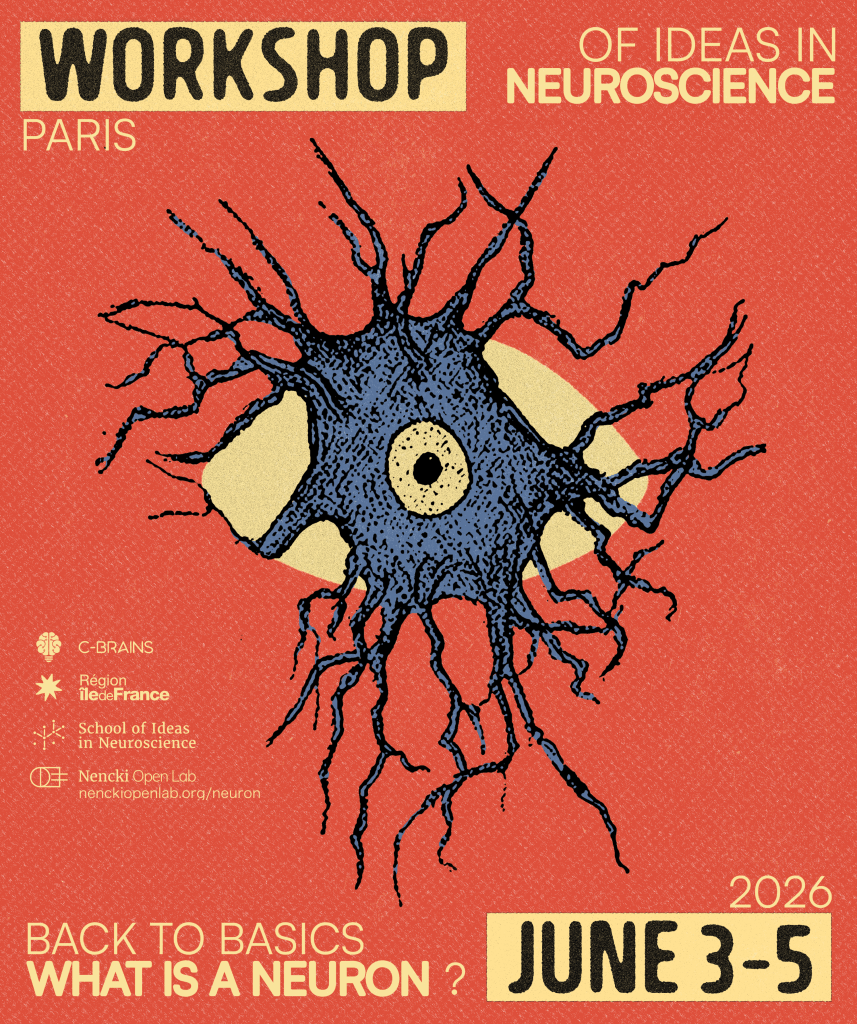
Paris, June 3 – 5th 2026
We are happy to announce the first workshop in our new series: Back to Basics!
The goal of this series is to take a fresh look at the basic assumptions held in our field.
In the first workshop, we will ask the most fundamental question: What is a neuron? What properties should a cell have to be defined as such? An answer to this question may seem obvious at first: it has to be a cell that uses electrical signals, is connected to other neurons by synapses, and has extended processes—axons and dendrites.
But the deeper we dig, the more challenging counterexamples we encounter: clearly non-neural cells using action potentials; neurons without axons or dendrites; or whole nerve nets in jellyfish that form a syncytium. Even more exciting is the possibility that the nervous system—and neurons—evolved at least twice independently, and that much of the neuronal molecular machinery was already present before the evolution of animals.
And what defines a neuron during development, and how do its developmental pathways differ from those of other cells? Can we draw clear boundaries between neural and non-neural states? How do different experimental approaches—in vivo, in vitro, or using brain organoids—shape the way we define a neuron?
Things are no easier in an artificial neural network: what exactly is a processing unit in an ANN? How does it correspond to a biological neuron, and what can we learn from these models?
The aim of this workshop is to look closely at different ways of defining a biological or artificial neuron and to tackle some important questions:
- Can we clearly define a biological neuron?
- How many times did neurons evolve? What do the differences between different phyla tell us about the necessary and sufficient properties of a neuron?
- What was the evolutionary precursor of a neural cell?
- What defines a neuron during development?
- How do neurons relate to other types of cells that fulfill similar functions?
- What is a neuron in an artificial network? What properties does it share with a biological neuron?
This workshop will be held in the spirit of our Schools of Ideas—with an informal atmosphere, open exchange of thoughts and perspectives, in-depth talks, and plenty of space for discussion.
Speakers:
- Clarisse Brunet (Institut Curie)
- Thibaut Brunet (Institut Pasteur)
- Bassem Hassan (Paris Brain Institute)
- Fred Keijzer (University of Groningen)
- Aneta Koseska (Max Planck Institute for Neurobiology of Behavior)
Instructors:
- Anna Chrzanowska (Paris Brain Institute)
- Jules Duruz (COS, Heidelberg University)
- Klara Finta (Charité – Universitätsmedizin Berlin)
- Natalia Krasilshchikova (Universität Bonn)
- Mateusz Kostecki (Heidelberg University)
- Azul Silva (Sorbonne University)
- Urszula Wlodkowska (Nencki Institute)
Participation fee is EUR 350 (we offer fee waivers). You can find the application form HERE.
Application deadline: April 2nd.
 Nencki Open Lab